Cart
0
Deodorant vs. Underarm Serum: What’s the Difference—and Do You Need Both?
For years, the standard underarm routine has been simple: wash, apply deodorant and move on.
But deodorant was never designed to address everything the underarm skin experiences. Shaving, friction, sweat, tight clothing and repeated product application can leave the area feeling dry, irritated, bumpy or visibly uneven.
That is where underarm serum comes in.
Deodorant and underarm serum are not interchangeable products. One primarily helps manage odor, while the other treats the underarms as skin—with needs that can include hydration, gentle exfoliation, soothing and support for a more even-looking tone.
Here is the difference between deodorant and underarm serum, how each one works and why there may be room for both in your routine.
What Does Deodorant Do?
Deodorant is primarily formulated to help control or mask body odor.
Sweat itself is not usually responsible for the smell associated with perspiration. Underarm odor develops when bacteria living on the skin break down components of sweat and other underarm secretions.[1]
Depending on the formula, deodorant may help by:
-
Masking odor with fragrance
-
Reducing the growth or activity of odor-associated bacteria
-
Absorbing moisture
-
Neutralizing odor-causing compounds
Deodorant does not necessarily stop you from sweating. Its primary role is odor management, not skin correction.
This also means that while deodorant may help you feel fresher throughout the day, most traditional deodorants are not specifically designed to address concerns such as underarm discoloration, shaving irritation, rough texture, dryness or ingrown hairs.
Deodorant vs. Antiperspirant: They Are Not the Same
Although the words are often used interchangeably, deodorant and antiperspirant perform different functions.
A deodorant helps control odor. An antiperspirant reduces perspiration by using active ingredients—typically aluminum-based compounds—to temporarily limit the flow of sweat from the sweat ducts.[2]
In the United States, the distinction is also regulatory. A standard deodorant is generally considered a cosmetic, while a product marketed as an antiperspirant is regulated as an over-the-counter drug because it affects a bodily function: perspiration.[3]
Many products combine both functions and are labeled as antiperspirant deodorants.
The distinction can be summarized simply:
-
Deodorant: Helps control body odor
-
Antiperspirant: Helps reduce sweat
-
Underarm serum: Helps care for the condition and appearance of the skin
What Is an Underarm Serum?
An underarm serum is a leave-on skincare product formulated specifically for the underarm area.
Just as a facial serum delivers targeted ingredients to address specific skin concerns, an underarm serum may be formulated to help improve the appearance of discoloration, replenish moisture, smooth rough texture and soothe skin exposed to frequent shaving and friction.
The exact benefits depend on the formula. There is no single universal definition or required ingredient list for an underarm serum, so it is important to look beyond the product name and examine what the formula is designed to do.
A thoughtfully formulated underarm serum may provide:
Support for a more even-looking skin tone
Repeated irritation can contribute to post-inflammatory hyperpigmentation, a process in which the skin produces excess pigment after inflammation or injury.
Shaving, friction and reactions to personal-care products are among the factors associated with underarm irritation and discoloration.[4] Because melanin-rich skin can be more prone to persistent post-inflammatory marks, a gentle approach is especially important.
Brightening ingredients such as niacinamide and kojic acid have been studied for their effects on the pathways involved in visible pigmentation. Research has found that topical niacinamide can reduce the appearance of hyperpigmentation, while kojic acid can inhibit tyrosinase, an enzyme involved in melanin production.[5][6]
Hydration and barrier support
Underarms are frequently washed, shaved and exposed to sweat, friction and personal-care products. These repeated stressors can leave the skin feeling dry or uncomfortable.
Humectants and conditioning ingredients such as glycerin, sodium hyaluronate and panthenol can help attract or retain moisture. Research on topical panthenol has also shown benefits for skin hydration and barrier recovery.[7]
Smoother-feeling skin
Some underarm serums contain gentle exfoliating or skin-renewing ingredients that help loosen dead surface cells. This can improve the feel of rough skin and reduce the appearance of dullness or uneven texture.
Exfoliation should remain gentle. Aggressive scrubbing or layering several strong active ingredients can cause more irritation—the very issue that may contribute to underarm discoloration in the first place.
Comfort after shaving
Hair removal can create friction and small amounts of inflammation, especially when shaving without enough lubrication, applying too much pressure or repeatedly passing over the same area.
A well-formulated serum can help replenish moisture and soothe the skin between shaving sessions. It should not, however, be applied immediately after shaving when the skin feels cut, raw or visibly irritated unless the product directions specifically indicate that use.
Deodorant vs. Underarm Serum: The Key Differences
| Deodorant | Underarm serum | |
|---|---|---|
| Primary purpose | Helps control or mask odor | Cares for the skin |
| Reduces sweat? | Not unless it is also an antiperspirant | No |
| Targets discoloration? | Usually not its primary function | May help, depending on ingredients |
| Provides skincare benefits? | Sometimes, but typically secondary | Yes |
| Can hydrate the skin? | Depends on the formula | Often |
| Can be used together? | Yes | Yes |
The easiest way to understand the difference is this:
Deodorant manages what happens on the underarms. An underarm serum cares for the skin underneath.
Does an Underarm Serum Replace Deodorant?
Not necessarily.
An underarm serum is not automatically a deodorant or antiperspirant. Unless it is specifically formulated and marketed for odor control, it should not be expected to provide the same function as a daily deodorant.
Many people can benefit from using both products:
-
Apply underarm serum to clean, completely dry skin.
-
Allow it to absorb fully.
-
Follow with deodorant when needed.
This creates a more complete routine: the serum supports the appearance and condition of the skin, while the deodorant helps manage odor throughout the day.
Because formulas differ, always follow the application directions provided with each product. If layering causes pilling or discomfort, use the serum at night and deodorant in the morning.
When Should You Use an Underarm Serum?
An underarm serum can generally be incorporated into a morning or evening routine.
For daytime use:
-
Cleanse the underarms gently.
-
Dry the skin completely.
-
Apply a thin, even layer of serum.
-
Let it absorb.
-
Apply deodorant if desired.
For nighttime use, apply the serum after cleansing and allow it to remain on the skin overnight.
Consistency matters more than using a large amount. Changes in visible discoloration and texture usually take time because the skin needs to move through its natural renewal process.
Patch-test new products before applying them regularly, especially if you have sensitive skin or a history of reacting to deodorants, fragrance or exfoliating ingredients.
What Should You Look for in an Underarm Serum?
Choose a formula based on your primary skin concern.
For visible discoloration, look for ingredients such as:
-
Niacinamide
-
Kojic acid
-
Licorice-root derivatives
-
Gentle exfoliating acids
-
Vitamin C derivatives
For hydration and comfort, look for:
-
Glycerin
-
Panthenol
-
Hyaluronic acid or sodium hyaluronate
-
Aloe
-
Skin-conditioning botanical extracts
Avoid assuming that stronger is always better. The underarms are a high-friction area, and irritation can make discoloration appear worse. A balanced formula that combines targeted ingredients with hydrators and soothing agents may be more appropriate for consistent use than an aggressive peel or scrub.
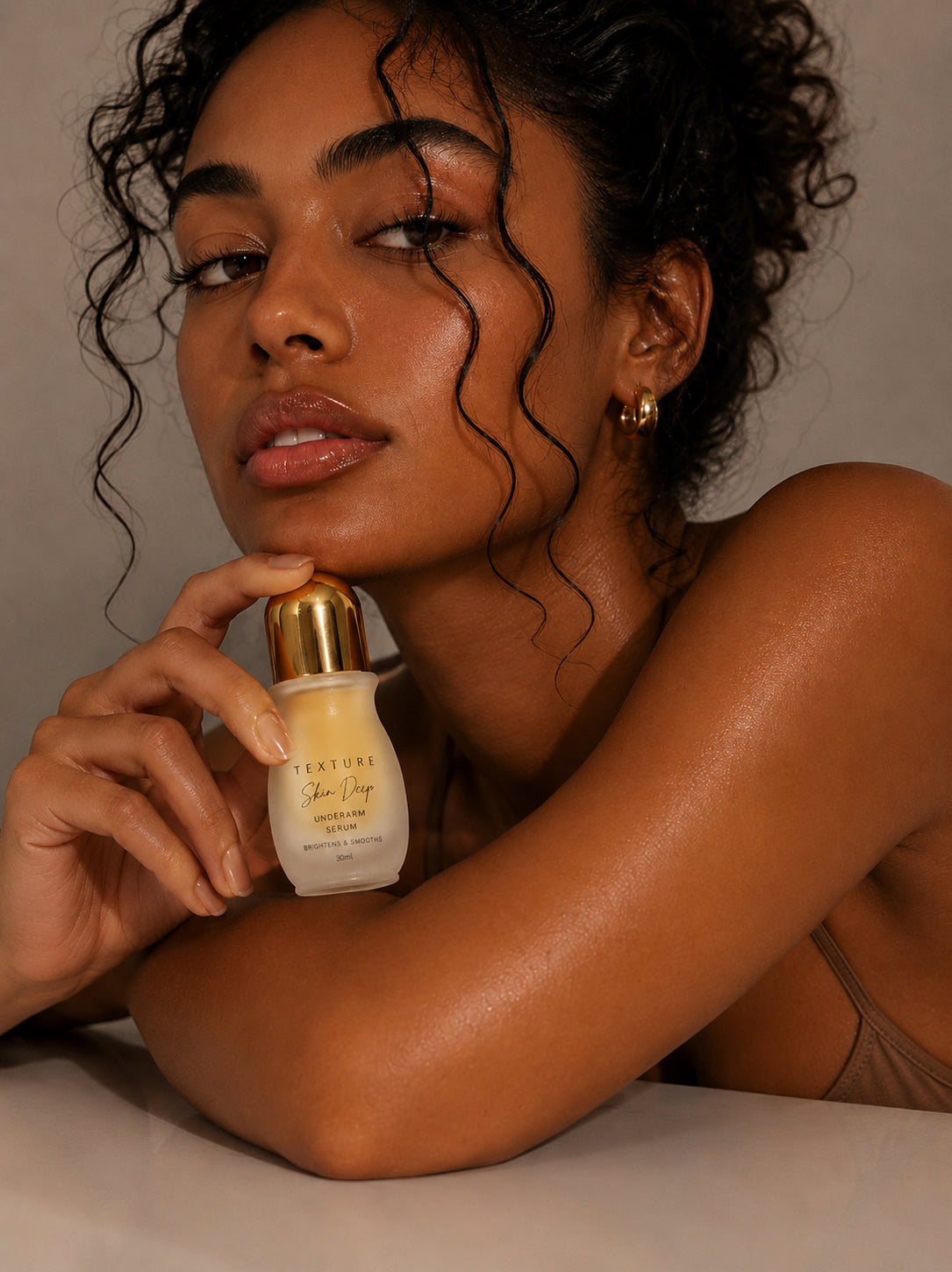
Meet Skin Deep: Underarm Skincare by Texture
Texture created Skin Deep Brightening Underarm Serum for an area that has traditionally been treated as an odor problem rather than as skin.
The leave-on formula combines niacinamide and kojic acid with hydrating and conditioning ingredients including glycerin, panthenol, sodium hyaluronate, aloe, cucumber, papaya and rice extracts.
Skin Deep is designed to help:
-
Brighten the appearance of uneven underarm tone
-
Smooth the look and feel of the skin
-
Replenish moisture
-
Soothe skin affected by daily friction and hair removal
It does not block sweat and is not an antiperspirant. Instead, it gives the underarms something the traditional routine has often left out: dedicated skincare.
The Bottom Line
Deodorant and underarm serum solve different problems.
Deodorant is made primarily to help manage body odor. Antiperspirant is made to reduce sweat. An underarm serum is made to care for the skin itself.
You may not have to choose between them. By pairing a targeted serum with the deodorant that works for your lifestyle, you can create an underarm routine that considers freshness, comfort, hydration, texture and visible tone.
Because your underarms deserve more than odor control.
Underarm skincare begins here.
Frequently Asked Questions
Can I apply underarm serum before deodorant?
Yes. Apply the serum to clean, dry skin and allow it to absorb fully before applying deodorant. You can also use the serum at night and deodorant in the morning.
Can underarm serum stop sweating?
No. A standard underarm serum does not reduce perspiration. Products designed to reduce sweat are regulated and labeled as antiperspirants.
Can an underarm serum help with dark underarms?
A serum containing evidence-supported brightening ingredients may help improve the appearance of some forms of discoloration with consistent use. However, dark or thickened underarm skin can sometimes be related to eczema, contact dermatitis, acanthosis nigricans or another underlying condition. Consult a medical professional when discoloration appears suddenly, becomes thick or velvety, causes significant discomfort or does not improve.
Can I use underarm serum immediately after shaving?
It is generally better to wait until the skin is calm, especially when the product contains exfoliating or brightening ingredients. Do not apply active products to broken, cut or severely irritated skin.
Is underarm serum the same as deodorant?
No. Deodorant focuses primarily on odor, while an underarm serum focuses on skincare concerns such as hydration, texture, irritation and uneven-looking tone.